A practice administrator comparing physician coding companies usually ends up with three slide decks promising the same accuracy, speed and specialty depth. None of them shows how the vendor would handle your own charts. Professional fee coding services decide how a physician group gets paid for every visit and procedure, so the choice deserves tests that produce evidence. This guide gives you three, covering specialty expertise, quality assurance (QA) and turnaround, and each one ends with five questions to take into a vendor call.
Every test depends on scoping the right work, so start with where physician coding begins and ends.
What Physician Coding Companies Do, and Where Professional Fee Coding Stops
Physician coding companies assign and validate the codes for the services a physician personally performs, from office visits and consults to hospital rounds and procedure days. That work sits in the mid cycle, between the signed note and the clean claim. Facility coding is a separate discipline with its own credentials, its own accuracy definitions and its own vendors. A partner with deep hospital experience may still struggle with a 40 provider multispecialty group, and scoping the wrong side of the ledger is the first expensive mistake.
Where the Professional Fee Boundary Sits
Professional fee coding covers the codes that pay the physician, while facility coding covers the codes that pay the hospital or surgery center. Billing is a third job, since coding assigns and validates the codes and billing submits the claim and follows it to payment. Confirm that each vendor is quoting for professional fee work alone, because blended proposals make accuracy and pricing hard to compare.
Four Rules that Make Physician Coding Difficult to Get Right
Four sets of rules drive most professional fee errors, and each leaves a trace in reports you already receive.
- E/M level selection. Office and outpatient visits in the 99202 through 99215 range are leveled on medical decision making or total time, so providers in one group often land at different levels for similar visits, which shows in your E/M distribution curve.
- Modifier 25. A significant, separately identifiable E/M visit on the same day as a minor procedure can be reported with modifier 25. The decision to perform the procedure is already included in the procedure payment, so the note must show work beyond that decision. Weak support shows up as coding denials.
- Shared and split visits. In the facility setting, the practitioner who performs the substantive portion bills the visit, meaning more than half the total time or the substantive part of the medical decision making, with modifier FS. Errors put the service under the wrong provider.
- Teaching physician attestation. When a resident provides the service, the record must show the teaching physician was present for the key portions and took part in managing the patient. Thin attestations surface in audits.
Once the scope is clear, the first test looks at who will actually code your charts.
How to Evaluate Specialty Expertise in Physician Coding Companies
You evaluate specialty expertise in physician coding companies by asking who will code your charts and then testing those coders on your own encounters. A client list tells you who signed a contract, and it leaves open who will work your cardiology or orthopedic charts. Specialty depth lives in individual coders, in their case history and in the continuing education they have completed this code year. A capable vendor can name them before you sign and show their work on a small sample of your encounters.
Start with Coder Assignment
Ask the vendor to describe the team assigned to your account by name, specialty and credential. CPC, CCS-P, CEMC and CRC credentials signal different strengths, and a strong team mixes them to fit your case mix. Then ask for a live exercise on three de-identified encounters from your practice. How a coder explains each choice tells you more than any capabilities deck can.
Five Questions On Specialty Expertise
Ask these five and get the answers in writing.
- Which coders will work our specialty mix, and what is their case history in it?
- What credentials do they hold, and what specialty education have they completed this code year?
- Will you code three of our dei-dentified encounters as a test, including one shared or split visit and one modifier 25 pairing?
- How do you handle teaching physicians and incidents to scenarios in a setting like ours?
- When an assigned coder leaves, how is our specialty knowledge handed over?
Expertise only matters if quality holds up month after month, which is what the second test measures.
How Do Physician Coding Companies Measure Coding Quality?
Physician coding companies measure coding quality through audits that produce an accuracy rate, and that rate means little until you know what it was divided by. Per code accuracy is the most flattering view, per chart accuracy is stricter and per claim accuracy is the strictest, because a single wrong code fails the whole claim. Audit teams that review tens of thousands of records every month treat the denominator as the first fact to state. Ask for it before comparing any two vendors, along with the sample size and audit frequency.
Every Accuracy Rate Needs A Denominator
Two vendors can both quote 98% and mean very different things. One may count every code on a chart and the other may count whole charts, which makes the second figure much harder to earn. Ask who performs the audit. Production staff checking their own team are measuring something different from an independent audit team with no stake in the result.
Five Questions On Quality Assurance
Five questions separate a measured program from a marketing number.
- What is your accuracy, per code, per chart or per claim, on what sample size and cadence?
- Who performs the audit, production QA staff or an independent team, and what credentials do the auditors hold?
- What is the inter-rater reliability (IRR) between your auditors, and how do you correct drift?
- Do we receive provider level scorecards, how often, and who delivers them to our physicians?
- What is the rebuttal path when we disagree with a finding, and what changes in education afterward?
Vendors are least prepared for question three, and an independent coding quality audit of the same sample of your charts settles it. Question five matters because findings change behavior only when they feed provider education programs.
Accurate codes still cost money when they arrive late, and turnaround is where definitions do the most damage.
What Is a Good Coding Turnaround Time for a Physician Practice?
A good coding turnaround time for a physician practice is one measured from note signature to clean claim, because that is the stretch a coding partner can actually control. Many vendors start the clock when a chart lands in their queue, leaving out interface delays, coding queries and holds. A vendor averaging 24 hours from receipt can still deliver a four day lag once a day of interface delay and two days of queries and holds are added. The longer clock is also the one where a fast coding partner earns its keep.
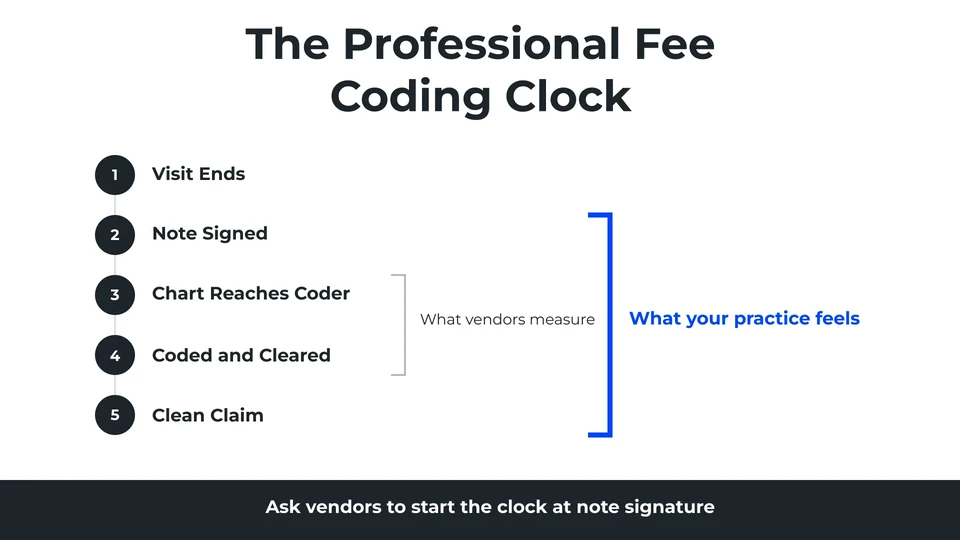
Start the Clock at Note Signature
Measuring from signature puts interface delays, coding queries and holds inside the visible lag, and it ties the vendor to a number that matches the cash it affects. Track provider signing lag separately as a practice side metric. A multistate urgent care network showed the payoff in an urgent care coding partnership, with coding completed within ten minutes of documentation and patient checkout times cut by 73%. Write the definition into the service level agreement (SLA) so it holds after signing.
Five Questions On Turnaround
Use these five to get the whole clock on paper.
- Where does your turnaround clock start and stop, and is provider signature time inside or outside it?
- What is turnaround by encounter type, such as office visits, procedure days and telehealth?
- What happens during a volume spike, a coder absence or a run of late signed notes?
- How do coding queries, holds and prebill edits count against the clock?
- What is the remedy when turnaround slips, and how often is performance reported to us?
With all three tests defined, compare the answers side by side before signing.
Questions to Ask A Physician Coding Company Before You Sign
The fifteen questions above reduce to one comparison you can run across every vendor on your shortlist. For each test, decide in advance what evidence you will accept in writing, what a strong answer sounds like and which answer ends the conversation. Doing this before the first call keeps a polished presentation from setting the standard, and it gives every vendor the same target. The table below summarizes all three tests, and it works best when you ask each question live and then request the answer in writing within a week.
| Test | Evidence to demand in writing | Strong answer | Red flag |
|---|---|---|---|
| Specialty expertise | Named coders, their credentials and a coded test sample from your charts | Named coders with case history in your specialties and a test set returned with rationale | A client logo slide and an offer to assign coders after signing |
| Quality assurance | Accuracy rate with its denominator, sample size, IRR and a sample provider scorecard | Per chart or per claim accuracy on a stated sample, independent auditors and monthly scorecards | One accuracy figure with no denominator or sample size |
| Turnaround | Clock start and stop points by encounter type, with the SLA remedy | A clock that starts at note signature, reported by encounter type, with a remedy for slips | A single average measured from receipt |
Four Risks and The Contract Control for Each
Most outsourcing problems trace back to the documentation that reaches the coder, which is why clinical documentation integrity support belongs in the coding conversation. Four risks come up most often, and each has a contract control.
- Losing the feedback loop. Require provider level scorecards on a fixed cadence so physicians keep hearing how documentation drives the code.
- Automation without review on complex encounters. E/M leveling depends heavily on documentation, so put in writing how these encounters reach a credentialed coder.
- A backlog spike during transition. Unbilled charges climb while a new team ramps up, so phase the move by specialty or location with an agreed backlog ceiling.
- Gaps in data protection. Confirm that HITRUST CSF or equivalent certification covers the team coding your charts, and add a right to audit clause.
A clear comparison still needs a schedule, and thirty days is enough to run all three tests.
How to Choose a Physician Coding Company in 30 Days
Choosing a physician coding company takes about four weeks when each week has one job. The sequence starts with your own numbers, because a vendor accuracy rate means little without your baseline beside it. It ends with a contract that holds the definitions you tested, especially the turnaround clock and the remedy when it slips. In between, every vendor answers the same fifteen questions and codes the same charts, which turns the decision into a comparison of findings. That shared sample keeps every vendor on equal footing.
A Four Week Evaluation Sequence
In week one, baseline your own accuracy, charge lag and cost per encounter. In week two, send the fifteen questions to your shortlist and ask whether pricing is per chart, per encounter or per hour. In week three, run a paid audit of the same chart sample with two vendors and compare findings. In week four, check references in your specialty and size band, negotiate the turnaround definition and SLA remedy, then phase the transition.
The same evidence standard applies to every partner. LexiCode, an XBP Global brand, publishes the figures this guide asks for, including 98% coding accuracy, more than 15 million records coded each year and 50,770 records audited monthly by AHIMA credentialed auditors, along with HITRUST CSF certification. Its work runs within the XBP Global revenue cycle framework, connecting front end accuracy to back end financial performance.
All three tests resolve to evidence. Physician coding companies should prove expertise with named coders, quality with a stated denominator and turnaround with a clock that starts at note signature. To see how that evidence would look for your practice, talk to the professional fee coding team at LexiCode.