[CPT 2026 and ICD-10-CM FY2026]
Consider this scenario. A payer is requesting documentation on forty-one encounters from the past eighteen months, all of them office visits billed alongside a same-day procedure. The money has already been paid, spent, and reported. Post-payment review is the single most uncomfortable thing that happens in dermatology medical billing and coding, because the exposure is retrospective and the defence is whatever the dermatologist happened to write two winters ago. Most practices discover their coding accuracy at exactly this moment.
Why Dermatology Generates More Denials Than Its Volume Suggests
Dermatology runs high procedure counts at low individual dollar values, which changes how coding error behaves. A hospital sees error arrive as one dramatic denial. A dermatology practice sees it as a fractional loss on hundreds of encounters, invisible per claim and material per year. Providers such as LexiCode describe this as leakage, since most of it never triggers a rejection at all. The claim pays, it simply pays less than the documented work supported. Four drivers produce almost all of it, and none are careless.
| Driver | What it does to the money |
|---|---|
| High volume, low unit value | A single downcoded excision costs little. Four hundred of them fund a coder |
| Same-day visit plus procedure | Whether both are paid turns on one two-character decision and the note behind it |
| Multiple lesions in one encounter | Bundling edits assume relatedness the record has to disprove |
| Documentation written for the chart | Clinicians record what they treated, not what the claim needs to defend it |
The four leaks below account for most of the annual number.
Where Dermatology Practices Lose Revenue on Coding
Dermatology practices lose revenue on coding in six specific places, and in every one the loss runs both directions. Choose too low and the claim underpays silently. Choose too high and it pays now and is recovered later with interest. Coding partners including LexiCode audit professional fee and surgical encounters precisely because these six decisions carry more variance than anything else in the specialty. Each one below names the decision, what the record has to show for it to hold, and what happens when it does not.
Lesion Excision, Diameter Plus Margins, and the Benign or Malignant Split
The excision code is selected on excised diameter plus the narrowest margin on each side, measured before removal while the tissue is still on the patient. Measure after excision and the specimen has shrunk, the recorded size drops a tier, and the practice underpays itself permanently. The benign and malignant families are separately numbered, and the pathology result decides which applies.
Destruction, Shave Removal, and Excision Are Three Families
A clinician may describe all three as removing a lesion. Coding treats them as distinct procedures with distinct payment. Destruction covers ablative methods, shave removal is tangential and does not require closure, and excision is full-thickness through the dermis. The operative note must state the technique explicitly, because the coder cannot infer depth from the word removed.
Biopsy Method and the Single Plus Each-Additional Structure
Tangential, punch, and incisional biopsies sit in separate code families, and each carries a primary code plus an add-on for additional lesions. Reporting the primary code multiple times where the add-on applies is a common and quiet error. The record must name the method and identify each lesion separately for the add-on to hold.
Mohs Surgery, Stages, and Tissue Blocks
Mohs reporting turns on the number of stages and the number of tissue blocks within each stage, both of which the surgeon must record contemporaneously. Where the same physician performs the surgery and reads the pathology, separate reporting of a diagnostic biopsy depends on whether the diagnosis was established beforehand and whether a separate specimen was taken.
Repair and Closure, Bundled or Separately Reported
Simple closure is included in the excision and is not separately reportable. Intermediate and complex repair are, and the distinction rests on layered closure, extensive undermining, or debridement documented in the note. A note reading closed with sutures supports the bundled option only, which is a repair the practice performed and will not be paid for.
Anatomic Site, Laterality, and the Pathology Component
Excision payment varies by anatomic site, so trunk, extremity, face, and scalp must be recorded distinctly, with laterality where it applies. Where the practice reads its own slides, the professional component carries modifier 26 and the technical component carries TC, and which the practice may report depends on what it owns and staffs. A national subspecialty pathology lab worked with LexiCode on exactly this reporting boundary.
Two modifiers decide more of this than the six leaks combined.
Modifier 25, Modifier 59, and NCCI Bundling
Modifier 25 and modifier 59 carry most of the audit exposure in dermatology medical billing and coding, and most of the recoverable underpayment, at the same time. A dermatology medical coding company earns its fee on this distinction more than on any other, which is why LexiCode audits target denials and payer-specific patterns here first. The National Correct Coding Initiative, or NCCI, publishes edit pairs presuming two services are components of one another, and these modifiers are how a practice asserts otherwise. Discipline is the answer in both directions, since fear and reflex both cost money.
Modifier 25 and the Separately Identifiable Visit
Modifier 25 asserts that a significant, separately identifiable evaluation and management service occurred alongside the same-day procedure. The record has to show a distinct history, examination, or decision beyond the work inherent in the procedure itself. A note that documents only the lesion and its removal supports the procedure alone. A multi-state urgent care provider working with LexiCode faced this exact pattern, where clinicians assigned their own codes without depth in evaluation and management guidelines.
Modifier 59 and the More Specific X Subset
Modifier 59 separates procedures the NCCI edits would otherwise bundle, usually on distinct anatomic sites or separate lesions. The XE, XS, XP, and XU subset states the reason explicitly and is preferred wherever the payer accepts it. Identify each lesion by site in the record, since a modifier asserting distinctness against a note that does not distinguish is an audit finding waiting to be written.
Global Periods and the Post-Procedure Visit
Excisions carry global periods, and visits inside that window are presumed included. Modifier 24 covers an unrelated visit, 58 a staged procedure, 78 an unplanned return to the operating room, and 79 an unrelated procedure. Medically unlikely edits also cap units per encounter, and injectable drugs need dose, units, and wastage documented against the HCPCS code. LexiCode handles coding-related denials and appeals where these edits are applied incorrectly.
When A Dermatology Specialty Partner Improves Collections
A dermatology specialty partner improves collections when there is a measured accuracy gap to close, and not by default. That qualification is the whole answer, and any vendor page telling you otherwise is selling something. A well-audited in-house coder who knows your dermatologists, your documentation habits, and your payer mix wins several rows in the table below outright, and switching away from one of those is usually a mistake that costs more than it recovers. The comparison holds only where the four conditions that follow it are genuinely present in your practice today.
| Criterion | In-house | Specialty partner | Hybrid |
|---|---|---|---|
| Cost structure | Fixed, steps with each hire | Variable, moves with volume | Variable on the outsourced portion |
| Accuracy assurance | Self-audited, if audited | Contractually defined with a method | Partner audits, practice codes |
| Specialty depth | Deep on your practice, narrow overall | Broad across dermatology volume | Both, on the work that needs it |
| Coverage during absence | Overtime or backlog | Contracted bench | Overflow absorbs the gap |
| Turnaround | Bounded by your staffing | Contracted, measurable | Peaks smoothed |
| Technology access | What you license | Included in the engagement | Included on the outsourced portion |
| Compliance liability | Held and controlled internally | Allocated by contract, held by you in practice | Split, defined in scope |
Where In-House Dermatology Coding Still Wins
Institutional knowledge is the row nobody buys back quickly. A coder who has watched your surgeons document for six years reads a note faster and queries less. Proximity produces query turnaround; a remote arrangement works hard to match, and transition risk is zero when the model already runs. If your accuracy is measured, documented, and good, nothing here argues for changing it.
The Four Conditions Under Which a Partner Changes the Number
A documented accuracy gap, found by audit and not assumed. Unfilled coder positions producing unbilled days. Growth or acquisition adding volume faster than hiring can. Or a payer review already underway, where independent review carries weight your own re-code does not.
Which raises what to actually ask.
What to Look for in a Dermatology Coding Partner
What to look for in a dermatology coding partner is evidence, not a deck. Five numbers separate a serious operation from a competent salesperson, and every one of them should arrive in writing before anybody signs anything. Programs run to a documented standard, LexiCode among them, hold accuracy through audit databases tracking findings over time and a second-level quality assurance review before any recommendation leaves the building. Ask what infrastructure produces the number, because a rate quoted without a method behind it is a marketing claim wearing a decimal point.
| Number to request | What a weak answer sounds like |
|---|---|
| Measured accuracy and the denominator behind it | A percentage with no method attached |
| Audit sample size and cadence | “We audit regularly” |
| Coder credential mix and how many carry dermatology volume | “All our coders are certified” |
| Turnaround measured from note signature, not from receipt | “Twenty-four hour turnaround,” unqualified |
| Denial overturn rate on coding-related denials | “We handle appeals” |
LexiCode publishes 98 percent coding accuracy, 50,770 records audited each month, and AHIMA-certified auditors, which is what those five answers look like when a partner can produce them.
The One Dermatology Question That Separates a Specialist From a Generalist
Ask how they would handle a multi-lesion encounter with a same-day problem visit. A specialist asks about the lesions, the sites, the pathology results, and what the note says about the visit before answering. A generalist answers immediately. The hesitation is the qualification.
Outsourcing carries real risk, and pretending otherwise helps nobody.
The Risks of Outsourcing Dermatology Coding
Outsourcing dermatology billing and coding introduces four risks worth naming plainly, because any partner who will not discuss them openly has not run enough transitions to know what breaks. LexiCode addresses the documentation half through clinical documentation integrity support, using dually certified reviewers working both retrospectively and concurrently, which closes one of the four risks and leaves the other three entirely live. Each risk below pairs with the contract term or process control that answers it, and every one should be settled before the first chart moves.
| Risk | The control that answers it |
|---|---|
| Losing the feedback loop to your dermatologists | Contracted query volume, provider education cadence, and named clinical contacts |
| Transition backlog spike during ramp | Phased cutover by service line, parallel running, and a dated backlog clearance target |
| Protected health information and delivery model | Business associate agreement, HITRUST CSF certification, named delivery locations and supervision |
| Over-reliance on automation | Human review mandated on lesion, Mohs, and multi-procedure encounters |
Automation deserves the same honesty. Autonomous coding suits high-volume, low-variability work far better than a multi-lesion dermatology encounter where measurements, margins, and a pathology result decide the code. Human review is the control, not the fallback.
How to Outsource Dermatology Medical Billing and Coding in 30 Days
How to outsource dermatology medical billing and coding starts with your own numbers, never with a shortlist. Baseline first and the decision can legitimately land either way, which is precisely what makes it a decision and not a formality. Partners including LexiCode will run a blind paid audit on a chart sample you choose yourself, and putting two vendors through the identical sample is the only way a quality comparison means anything at all. Two of the four weeks below involve no vendor whatsoever, and that is entirely deliberate.
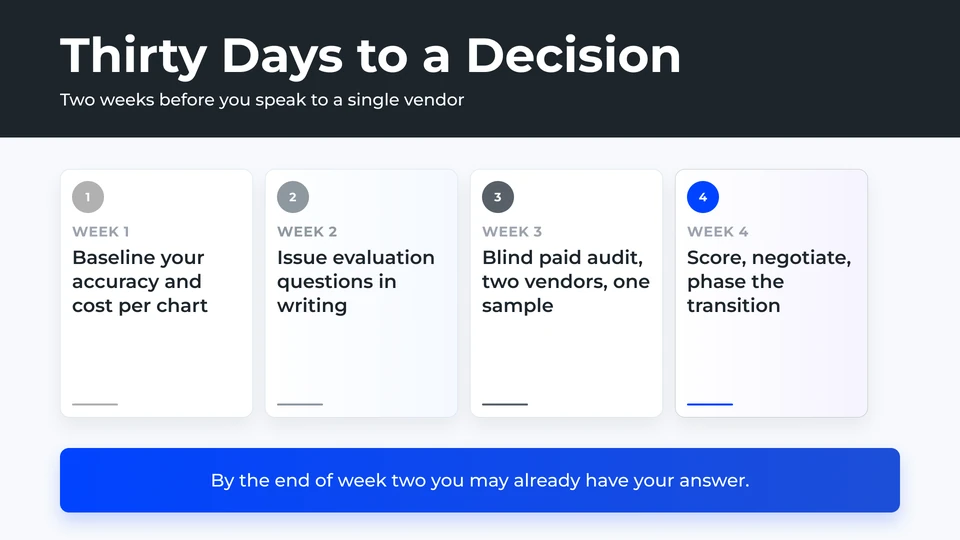
| Week | Action | Vendor involved |
|---|---|---|
| Week 1 | Baseline your own coding accuracy and cost per chart on a sample of real dermatology encounters through a baseline coding accuracy audit | No |
| Week 2 | Shortlist and issue the five evaluation questions in writing, plus the multi-lesion test question | No |
| Week 3 | Run a paid blind audit of the same chart sample against two vendors | Yes |
| Week 4 | Score the answers, negotiate the service level agreement and exit assistance, and phase the transition | Yes |
Week two is worth doing whatever you decide about week four.
Frequently Asked Questions
Three questions come up in almost every evaluation.
Can a coding partner handle Mohs surgery and pathology coding?
Ask specifically. Mohs reporting turns on stages and tissue blocks, and pathology reporting turns on component ownership. A partner coding general dermatology competently may still lack Mohs volume, so ask how many coders carry it and request a sample review.
Will a partner reduce our modifier 25 denials?
Only by fixing what the notes say. Modifier 25 denials are documentation findings before they are coding findings, so the mechanism is provider education and query discipline. A partner promising fewer denials without touching documentation is describing an outcome with no cause.
Is outsourced dermatology coding HIPAA compliant?
It has to be. A business associate agreement is the baseline, and HITRUST CSF certification indicates independently assessed controls above it. Ask which delivery locations handle your charts and who supervises them.
Choosing a Dermatology Medical Billing and Coding Partner
A partner improves dermatology medical billing and coding collections when there is a measured gap to close. Not when a deck is persuasive, and not because outsourcing is fashionable this year. The sequence matters more than the shortlist, which is why every recommendation here starts with measuring your own charts before anyone else measures them for you. Start with medical coding services scoped to what you actually need.